The Hallway Is a Route Before It Is a Room
A clear hallway route makes a city home easier to use. Learn what belongs near the door, what should move elsewhere, and how to choose a layout.
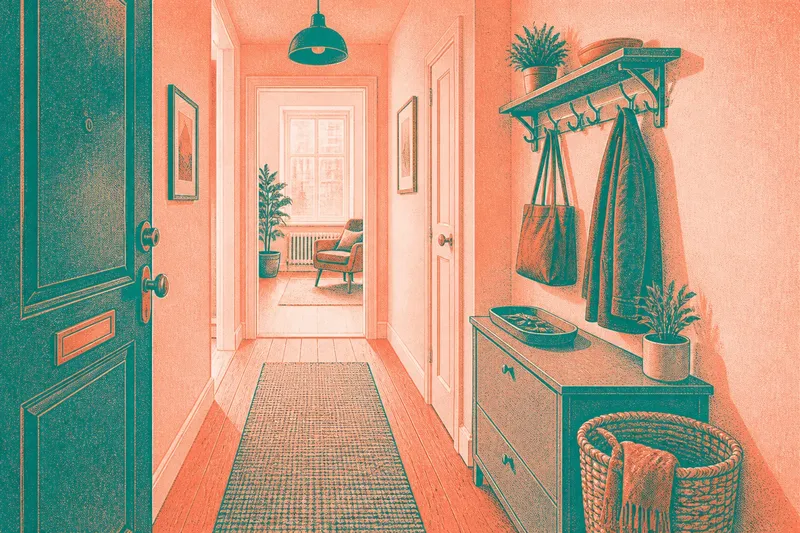
The most common hallway mistake is treating every empty patch of wall as storage space. A shoe rack, coat hooks, a parcel, and a chair can each seem useful on their own; together, they turn the route from the door into a daily obstacle course. A clear hallway layout starts by protecting the path people actually take, then assigns a limited place to the things that support that journey.
That does not mean a hallway must be bare. It means its furnishings should earn their place by helping someone arrive, leave, or pass through without hesitation. For a narrow city entry, that distinction can matter more than whether a piece looks small in a furniture listing.
Protect the route before choosing hallway storage
Think of the hallway as a connection between rooms, not as a spare room waiting to be filled. The route begins where the door swings open and continues toward the rooms people use. It may also need to accommodate a person carrying groceries, someone passing in the opposite direction, or a visitor removing a coat.
Walk the route with your hands full. Notice where the door opens, where you naturally turn, and which spots feel awkward when you pass another person. Keep those areas free of furniture and belongings. If the hallway has a turn, a doorway, or a radiator, treat it as part of the route rather than a convenient corner to fill.
A useful test is whether an item makes an ordinary transition simpler. A small landing surface may help someone set down keys while unlocking the door. A deep cabinet that forces people to sidestep may create more friction than it removes. The aim is not to fit the greatest number of objects; it is to let necessary objects serve the route without taking it over.
Choose a landing zone for items used at the door
A landing zone is a designated place for belongings that come in or go out with you. Keys, a frequently used tote, and a small amount of current mail may belong there because they need attention at the threshold. Items used less often, such as seasonal accessories or spare linens, generally do not need prime hallway space.
There are three common approaches. Each suits a different entry and household routine:
- A wall-mounted landing zone: A few hooks, a narrow key rail, or a shallow shelf keeps the floor open. It suits a tight hallway, especially when household members can agree on what each hook or shelf is for. It is less suitable when everyone needs more hanging space than the wall can comfortably hold.
- A slim freestanding piece: A narrow console or compact shoe cabinet gives loose items a defined home. It suits a hallway with a usable wall outside the main path and people who prefer closed storage. Its depth and door swing matter: a cabinet can look restrained while still obstructing a doorway or passage.
- A room-adjacent landing zone: A basket, hook, or small drawer just inside a nearby kitchen or living area takes pressure off a very narrow entry. It suits households whose daily routine already passes that spot. It may be inconvenient if people enter, drop their belongings, and then need to backtrack to put them away.
Say you enter a small apartment with a shallow wall beside the door and no room for a cabinet. You might place a key rail and two coat hooks there, then keep a lidded basket in the nearby closet for scarves that are not used every day. The expected observable result is that the floor stays open, while the items needed at the door remain easy to find.
Give occasional items a home outside the main path
Occasional items are belongings that visit the hallway briefly but do not need to live there: a return parcel, a borrowed umbrella, a bag for a planned donation, or a piece of mail awaiting attention. Their short stay can become permanent if there is no clear destination. The answer is a temporary holding spot with a boundary, not an expanding collection of hooks and baskets.
Choose a place that is visible enough to prompt action but does not narrow the route. A shallow tray can contain keys and mail; a small basket can hold an umbrella or reusable bags. For parcels or donations, a closet shelf or a spot inside a nearby room may be better than leaving a box by the door. The best location depends on what happens next: an item awaiting a trip outside should be easy to pick up, while something that needs sorting should sit near where that task normally happens.
Make the boundary physical and simple. A basket that holds only current outgoing items has a natural limit. When it fills, one item needs to leave or move to its proper storage place before another arrives. A large bin intended to catch everything has the opposite effect: it makes postponement feel like a storage system.
Match the layout to the way the household arrives
The right approach depends less on a style label than on the entry routine. A household with one regular commuter may need a dedicated spot for a coat, bag, and keys. A home with several people arriving at different times may benefit from separate hooks or clearly divided cubbies, provided those fixtures do not crowd the route. A household that rarely uses the front door may need very little there.
Consider these distinctions before adding furniture:
- If shoes are removed at the door, choose contained shoe storage only if it leaves the route clear; otherwise, use a nearby closet or room-side rack.
- If coats accumulate, assign hooks to current-use coats and store off-season pieces elsewhere.
- If mail is often forgotten, put a small tray near the place where someone naturally pauses, then sort it as part of an existing routine.
- If bags are dropped on the floor, use one reachable hook or basket for the bags that leave the home regularly rather than adding a hook for every possible item.
It is not worth matching every container or buying a dedicated organizer for each object. A simple hook and a reused basket can do the job if their locations fit the route and the household uses them. The useful detail is the assignment: everyone should be able to tell what belongs there and what should move on.
Check the hallway layout before you commit?
Should a hallway have furniture?
Only if the piece supports arrival, departure, or passage without obstructing the route. A shallow shelf may help in one entry, while an empty wall is the better choice in another.
Where should shoes go in a narrow hallway?
Start with the place shoes are actually removed, then check whether a rack or cabinet leaves comfortable passage and does not interfere with doors. If it crowds the entry, move shoe storage to a nearby closet or room instead.
What belongs in a hallway basket?
Use it for a limited group of items with the same next action, such as reusable bags ready for the next outing. Avoid mixing those with unrelated belongings, since a catch-all basket tends to become permanent overflow.
How can an entry stay tidy when several people share it?
Give each person a clear, reachable place for the items they use at the door, and keep the number of shared surfaces small. If belongings still collect on the floor, move or reduce the storage rather than adding more containers by default.
Use a simple decision to settle the layout
Before buying anything, remove the items that do not belong in the hallway and try the remaining arrangement without new furniture. Then ask whether each proposed item has a defined job, whether it can be reached without blocking another person, and whether there is a better home just beyond the entry. If one of those answers is no, the hallway may not be the right place for it.
Hallway layout works best when storage follows the route rather than competing with it. Keep the everyday landing zone close to the door, move occasional belongings to a limited holding spot, and send everything else to the room or closet where it is used. That small distinction lets the hallway do its most important work: getting people through the home without making them negotiate their belongings first.