One Desk, Two Corners: Choosing Between a Fold-Away and Fixed Workspace
Fold-away vs fixed compact desk choices depend on work frequency, nearby supplies, and how you want the room to feel once the workday is over.
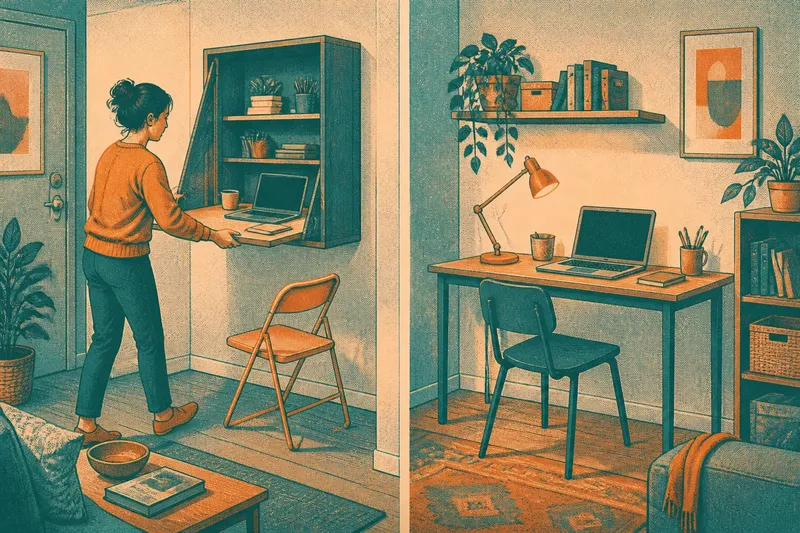
The common mistake with a small home office is choosing a fold-away desk because it seems to take up less room, then discovering that opening and clearing it is a daily chore. A fixed desk can occupy more visual space, but it may make starting work simpler. Fold-away vs fixed compact desk decisions are less about which desk is smaller and more about how often you work, what must stay within reach, and what you want the room to become afterward.
Choose around the routine, not the desk footprint
A fold-away desk is a work surface that closes against a wall or folds into a cabinet when it is not in use. A fixed compact desk stays in place, though it may have a shallow top, narrow legs, or storage designed for a limited room. Both can suit a small apartment; each asks you to make a different compromise.
Start by tracing a typical work session from beginning to end. Consider where the laptop lives, whether you use a separate keyboard or notebook, and how often you need papers, chargers, or reference books. Then consider the closing routine: does the surface need to disappear, or is it enough to leave the desk in place and put away a few items?
Frequency matters, but so does friction. If you work at home most weekdays, repeatedly unfolding a surface and reconnecting equipment can feel like an extra task. If the desk is used occasionally, a fold-away option may return valuable floor or wall space to another purpose. Neither pattern is universal: a frequent user who needs only a laptop may find a folding desk easy, while an occasional user with ongoing paperwork may prefer a fixed surface.
Notice what needs to stay close
A desk is not only a top. It is also a place for the objects that support work. Some supplies can be stored in a drawer or box; others are useful only when they remain ready. A monitor, desk lamp, keyboard, notebook, or charging cable can make the difference between a workspace that opens quickly and one that requires repeated setup.
With a fold-away desk, check where those objects go when the surface closes. A wall-mounted model may have a narrow interior shelf, while a cabinet desk may conceal a chair and supplies behind doors. These arrangements can tidy the room, but they limit what can remain connected or on display. A fixed desk can keep frequently used items in place, although it may need a drawer unit, wall shelf, or desktop organizer to prevent a small top from becoming crowded.
Think about the work itself, too. A laptop-based task may need little more than a clear surface and power nearby. Drawing, sewing, paperwork, or a second screen can call for more working area and supplies that are awkward to pack away. If a fold-away desk cannot accommodate the tools you actually use, its closed appearance may come at the cost of a frustrating setup.
Compare how each option changes the room
A fold-away desk changes the room in two states: open and closed. When closed, it can read as a cabinet, wall panel, or shallow shelf rather than office furniture. When open, it needs enough clearance for the top, chair, and a person using it. The room therefore has to work in both arrangements, not just look clear with the desk shut.
A fixed compact desk makes a more constant visual claim. Its legs and chair remain part of the room, but that presence can feel intentional if the desk aligns with a bookcase, sits under a window, or occupies an underused wall. It can also serve as a general-purpose surface when work is done, provided that this does not turn it into a permanent drop zone.
Consider what the desk faces and what it interrupts. A folding surface may be convenient behind a door only if the door and the open desk do not compete for the same space. A fixed desk can tuck beneath a window or beside a sofa, but avoid blocking a route through the room or making an everyday seat difficult to reach. The aim is not to hide every sign of work; it is to decide which room functions deserve priority.
Make the closing routine part of the choice
Before selecting a model, imagine the last few minutes of a work session. With a fixed desk, the routine might be putting papers in a tray, closing the laptop, and leaving the chair pushed in. With a fold-away desk, it may also involve removing objects, stowing a cable, folding the top, and moving the chair. A tidy closed state is useful only if its route to that state is manageable.
Say you work at the kitchen end of a studio and use a laptop, a compact keyboard, and a paper planner. If you work there occasionally and can keep the planner and keyboard in a nearby drawer, a fold-away desk could clear the shared room after the session. If you work there most days and prefer the keyboard, lamp, and planner to stay ready, a narrow fixed desk could reduce setup and make the corner feel like a stable work zone. In either case, the observable difference is the condition of the room after work: either the desk has closed away, or its essentials remain arranged on a compact surface.
It is not worth pursuing a desk that disappears completely if closing it requires shifting several objects to another room. Nor does a fixed desk need elaborate organizers to justify its place. A small tray for loose items and a dependable home for the chair may be enough to make the end-of-day routine feel settled.
What should you check before choosing?
How often will I use the desk?
Frequent use tends to favor a workspace that stays ready, while occasional use can make a fold-away surface more appealing. Treat this as a starting point, then account for how much setup you tolerate.
What has to remain on the surface?
List the objects you reach for during a normal session, including equipment that needs to stay connected. If they cannot be stored conveniently, a fixed desk may suit the routine better.
Will the open desk and chair fit comfortably?
Check the open position, chair movement, nearby doors, and the route through the room. A desk that closes neatly can still be awkward if using it blocks an everyday path.
Where will work items go afterward?
Choose a specific home for papers, cables, and small tools before deciding that a fold-away desk will clear the room. For a fixed desk, decide which items can remain visible without taking over the surface.
Choose the version that supports a real ending
The better choice is the one whose workday ending matches the way you use the room. A fold-away desk gives the space a clear change of state, but asks you to store and reset the tools. A fixed compact desk keeps a work surface ready, but asks you to accept its presence and maintain a simple boundary around it.
In the fold-away vs fixed compact desk comparison, look beyond the closed furniture and consider the whole sequence: sit down, work, put things away, and return the room to its next use. If that sequence fits your habits and leaves the corner usable for its other purpose, the desk is doing its job even when it is not the smallest option on paper.
Before buying, mark the proposed desk position with painter’s tape and place a chair where it would go. Try the route you would take to sit down and stand up, then imagine the same corner after work. That small check can reveal whether you need a surface that vanishes—or one that is simply easy to leave behind.